Internship program
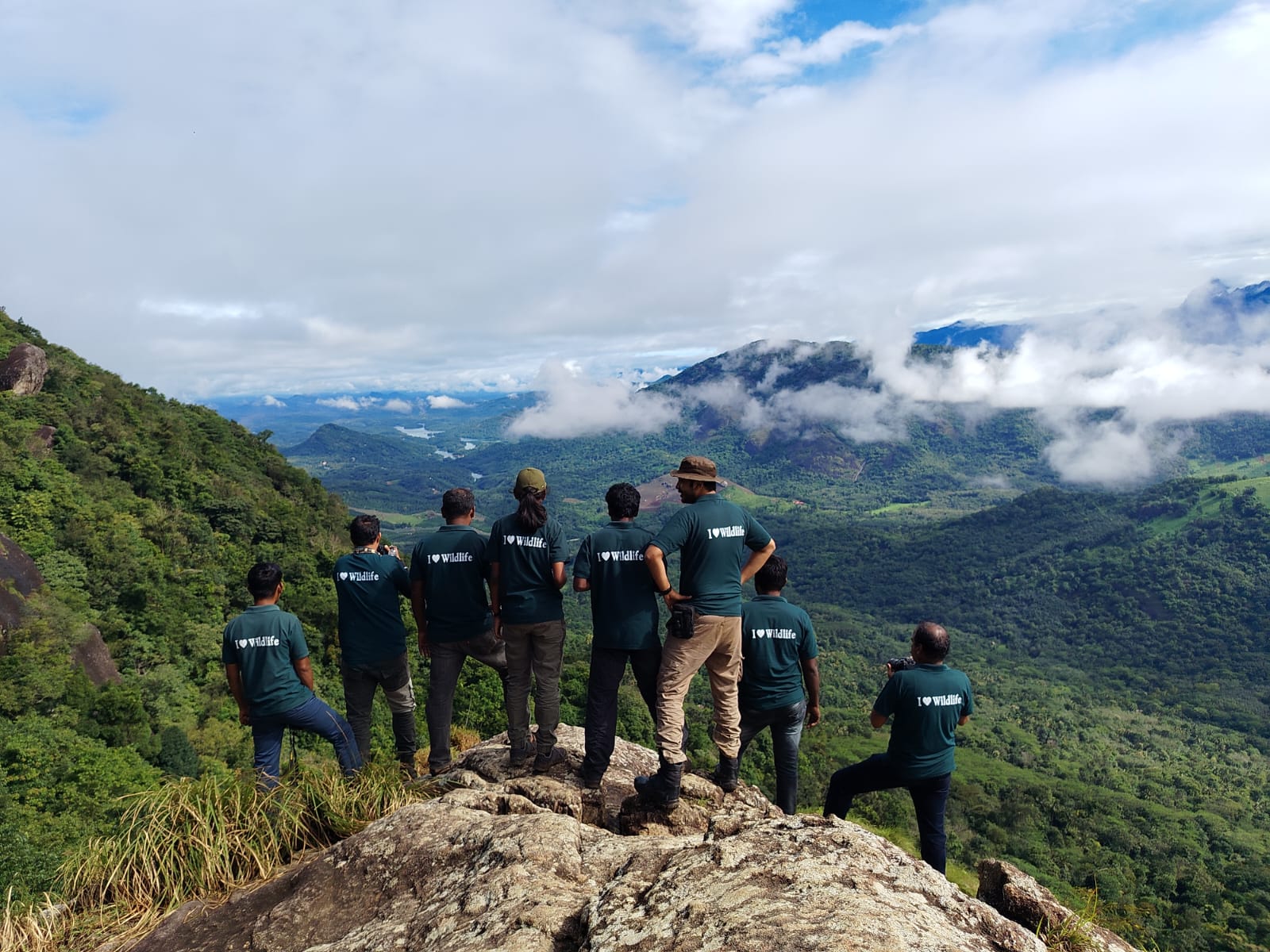
From May 17th to 22nd, the Kanniyakumari Nature Foundation conducted an immersive wildlife internship program for five first-year UG and one PG Zoology students from Lady Doak College at Khandige Wildlife Preservation.

Set amidst the misty hills and forests of Sirumalai, the internship was designed to take students beyond textbooks and classrooms into the living world of forests, insects, birds, and ecological interactions. For many students, this was their very first experience staying inside a forest landscape for an extended period, making the week both educational and transformative.

Entering the Forest
The journey began with excitement, curiosity, and a little nervousness. The peaceful atmosphere of Khandige Wildlife Preservation immediately gave everyone a sense of entering a completely different world — one ruled not by traffic and buildings, but by birdsong, insects, wind, and rain.
Unlike regular academic workshops, this internship focused on hands-on learning. Every trail, every insect, every bird call, and every fallen leaf became part of the classroom.
Morning Trail Walks and Birdwatching
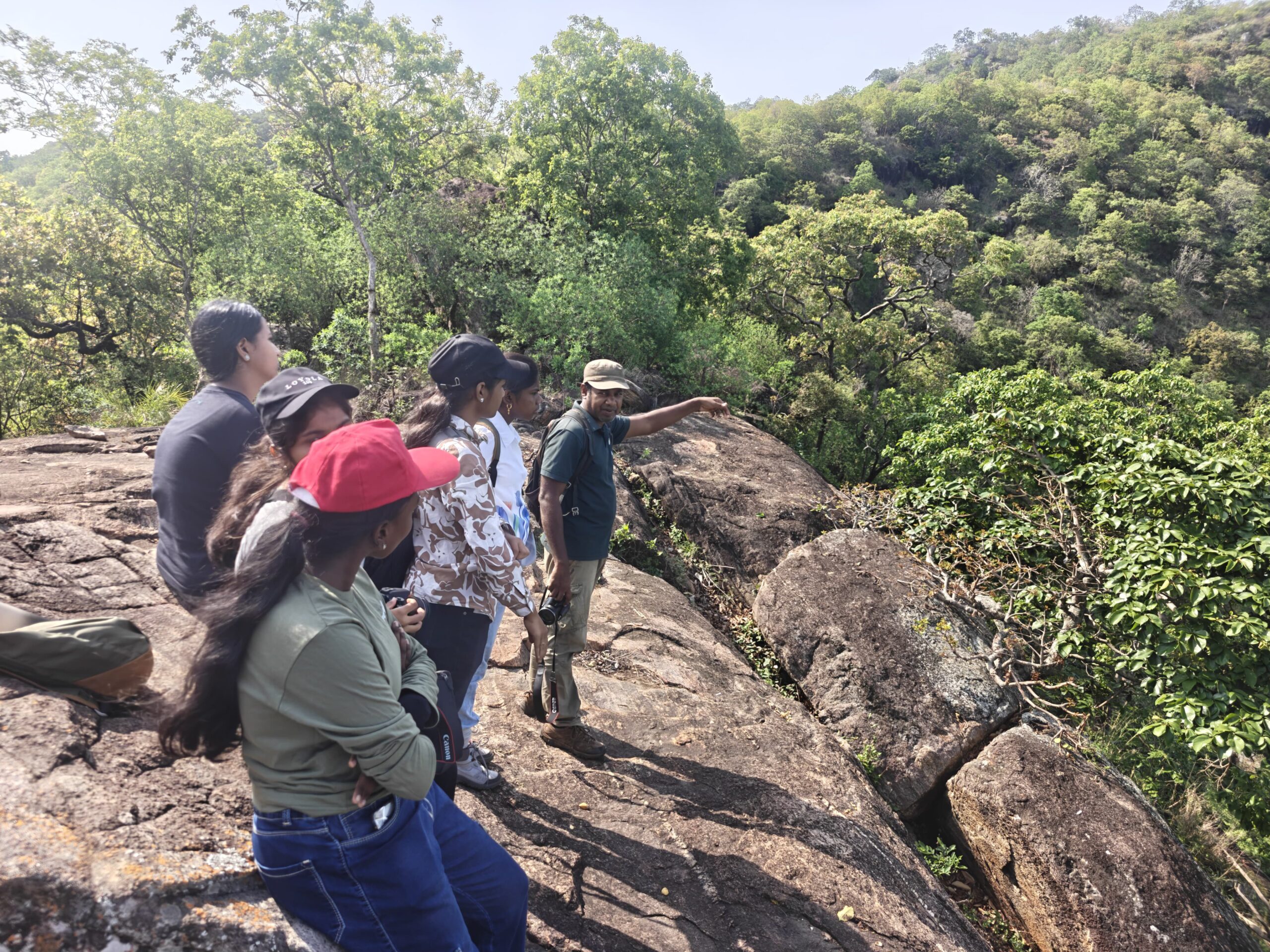
Each day started early, often before sunrise. The students assembled quietly with binoculars and notebooks in hand, stepping into forest trails while the hills were still wrapped in morning mist. These walks introduced them to the incredible diversity of birds found in the Khandige Wildlife Preservation.

Students learned how to identify birds not only through appearance but also through calls, behaviour, flight patterns, and habitat preferences. The forests echoed with the sounds of bulbuls, barbets, sunbirds, and orioles, while occasional raptors circled above the valleys.
For many participants, it was the first time they had observed birds so closely in their natural habitat. The excitement of spotting a new species through binoculars or identifying a call hidden deep within the forest created unforgettable moments.

The sessions also introduced students to ethical birdwatching practices — maintaining silence, respecting wildlife distance, and understanding the importance of habitats for migratory and resident birds alike.
A World of Butterflies
One of the highlights of the internship was butterfly observation and identification sessions. Sirumalai’s rich vegetation and varying elevations provided excellent opportunities to observe numerous butterfly species fluttering along forest paths, streams, and flowering patches.
Students were taught the basics of butterfly morphology, behaviour, mimicry, host plants, and seasonal movement. They learned how subtle differences in wing patterns, colours, and flight styles help distinguish one species from another.

Slowly, students who initially saw “just butterflies” began noticing details — the metallic shimmer of certain species, mud-puddling behaviour near wet patches, territorial fights, and the delicate relationship between butterflies and forest ecosystems.
The practical sessions encouraged observation skills and patience, essential qualities for any field biologist or naturalist.
Nights Filled with Moths
As daylight faded, the learning continued in a completely different form. One of the most exciting experiences for the students was moth screening. Students observed tiger moths, geometrids, hawk moths, and tiny micro moths gathering around the screen. The sessions also highlighted the ecological importance of moths as pollinators, prey species, and indicators of healthy ecosystems.

The forest at night offered an entirely different atmosphere — filled with insect sounds, distant owl calls, and the thrill of discovering creatures hidden during the daytime.
Understanding Climate Change Through the Forest
Apart from species identification, the internship also included educational sessions on climate change and environmental conservation.
Rather than learning only through presentations, students experienced the concepts directly through the forest itself. Discussions focused on habitat destruction, changing rainfall patterns, rising temperatures, invasive species, and their effects on biodiversity.

The students learned how sensitive ecosystems such as hill forests respond to climatic changes and how species distributions may shift over time. They also discussed the importance of citizen science, ecological documentation, and long-term monitoring in understanding environmental changes.
These conversations helped students connect theoretical ecological concepts with real-world observations around them.
Learning Through Citizen Science
A major focus of the internship was introducing students to modern biodiversity documentation tools such as the iNaturalist and eBird apps.
Students actively recorded birds, butterflies, moths, plants, fungi, and other organisms they encountered during the camp. They learned how to photograph species properly, upload observations, add location data, and contribute to global biodiversity databases.

The internship emphasized that even students and ordinary citizens can play a significant role in conservation through consistent observation and documentation.
More Than an Internship
As the days passed, the students slowly adapted to forest life. Simple moments became memorable — Cooking pasta on a rainy night, spotting a snake after it stuffed a bulbul fledgling, sighting Indian Gaurs very close to the camp, listening to nocturnal sounds, or watching clouds drift across the hills.
The internship also helped students build teamwork, observation skills, patience, and confidence in fieldwork. Many participants who initially hesitated to enter dense trails or identify species gradually became more comfortable and enthusiastic.

By the final day, the forest no longer felt unfamiliar. It had become a living classroom that taught lessons impossible to fully capture within four walls.
A Step Towards Future Conservationists
Programs like these highlight the importance of experiential learning in ecology and wildlife conservation. Through this internship, Kanniyakumari Nature Foundation not only introduced students to biodiversity but also encouraged them to observe nature more deeply and responsibly.
The week at Khandige Wildlife Preservation was not merely about identifying birds or butterflies — it was about developing curiosity, ecological awareness, and a connection with the natural world.

As the students left the hills carrying photographs, field notes, checklists, and memories, they also carried something more meaningful: a stronger understanding of why forests matter and why conservation is essential for the future.